- COLLABORATIONS
Sol.one Integrated Modular Unmanned Ground System.

About iMUGS
Key Benefits of the iMUGS Project:
- Enhanced Interoperability: iMUGS has established a European-wide architecture that integrates ground and aerial platforms, command, control, and communication equipment, sensors, payloads, and algorithms. This standardization ensures seamless collaboration between manned and unmanned systems across different EU member states, facilitating joint operations and resource sharing.
- Increased Mission Efficiency and Safety: By deploying unmanned systems in hazardous environments, iMUGS reduces the risk to humans. The UGVs can perform tasks such as reconnaissance, resupply, and casualty evacuation, thereby increasing operational efficiency and safeguarding personnel.
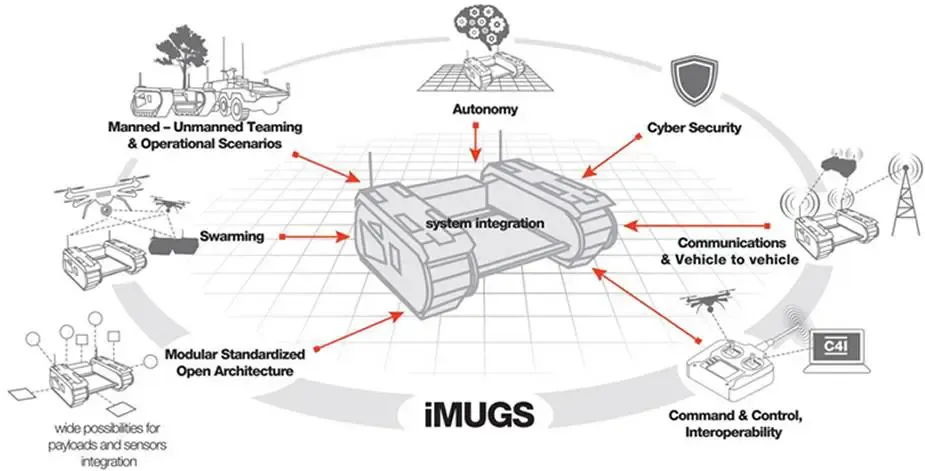
- Improved Situational Awareness: The UGVs developed under iMUGS are equipped with advanced sensors and communication systems that provide real-time data to operators. This capability enhances decision-making processes, allowing for quicker and more accurate responses during missions.
- Scalability and Modularity: The project's focus on a modular and scalable architecture allows for easy updates and modifications of assets and functionalities. This flexibility ensures that the system can adapt to a wide range of missions and evolving technological advancements.
- Strengthened EU Defense Collaboration: iMUGS exemplifies successful cooperation among multiple EU member states and industries, setting a precedent for future collaborative defense projects. This unity enhances the EU's strategic autonomy and collective security.
- Technological Advancement: The project has propelled the development of cutting-edge technologies in robotics and autonomous systems, positioning the EU as a leader in defense innovation. The integration of artificial intelligence and advanced control systems in UGVs showcases the EU's commitment to maintaining a competitive edge in defense capabilities.
Sol1's Role
Certified Ground Station
Sol1 brings in the certified ground station, which brings aircraft-level safety to the domain of UGV.
UGV Swarm Control
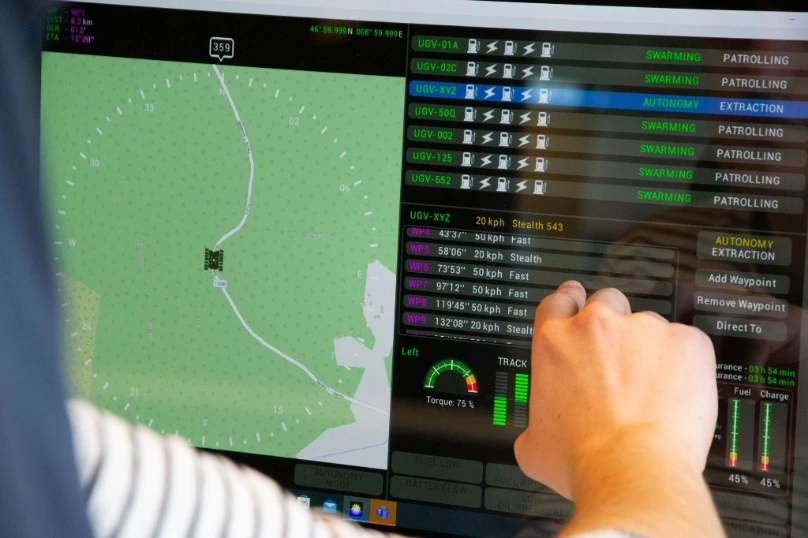
In the world of certified UAV, one pilot controls one flying UAV. The ground station was extended to visualize and control a large swarm of UGVs which are each doing a separate taks, using just a single pilot/operator.
UGV Autonomy Interaction
The UGVs have autonomy, and thus their actions may differ from the commanded actions. The user interface was updated to reflect this distinctions.
Distributed Data Service (DDS)
In this program, Sol1 developed and used OMG DDS on ROS2 in the context of our certified ground station.
UGV/UAV Teaming
Adding UGV commanding to the UAV ground station allows to define mixed missions. It also allows to use information obtained from the UAV to inform the UGV.
NATO STANAG 4609
Sol1 implemented the reception of STANAG 4609 video streams in the ground station.
Milrem THeMIS Integration
The Milrem THeMIS UGV remote operation was integrated into the ground station, using the video feeds directly from the robot and sending joystick control commands.
Partners

Milrem Robotics (coordinator), Estonia

Bittium, Finland

Diehl Defence, Germany

dotOcean, Belgium

GMV Aerospace and Defence, Spain

Insta Advance, Finland

Krauss-Maffei Wegmann (KMW), Germany

Latvijas Mobilais Telefons (LMT), Latvia

NEXTER Systems, France
Royal Military Academy, Belgium

Sol.One, Belgium

Safran Electronics & Defense, France

Talgen Cybersecurity, Estonia
Feel free to contact us. Start the conversation about your UAV programme
